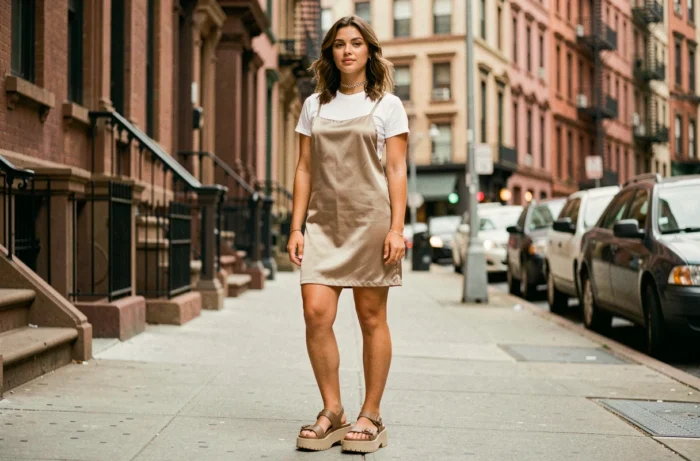
In 1995, women’s and men’s fashion was structured around three distinct axes: minimalism championed by houses like Jil Sander and Prada, late grunge inherited from the alternative scene, and a techno-minimalist futurism that is still not well documented today. These three currents coexisted on the runways and in the streets, producing very different silhouettes depending on each person’s cultural references.
Prada’s techno-minimalist futurism: the forgotten axis of 1995
Retrospectives dedicated to the mid-1990s almost always cite grunge and slip dresses. However, a third current deserves special attention: techno-minimalist futurism, of which Prada was the main vector.
The silhouettes proposed by the Italian house borrowed from sportswear, featuring technical materials, clean cuts, and a cool palette. During archival presentations organized in 2026, these pieces were deemed quite contemporary by the specialized press, according to Vogue.
This current distinguished itself from classic minimalism (that of Jil Sander, focused on neutral suits and straight lines) by its relationship with textile technology. While Jil Sander sought the perfection of a sober cut, Prada integrated nylons and industrial finishes that gave the garments an almost utilitarian look. This approach significantly influenced the iconic styles of 1995 that current collections continue to reinterpret.
Alexander McQueen Fall-Winter 1995: Fashion and Political Reading
Alexander McQueen’s Fall-Winter 1995 show was not simply about clothing provocation. The torn tartans, deliberately distressed tailoring, and exposed bodies carried an explicit political charge: evoking the historical violence exerted by England against Scotland.
This dimension is documented in the book Dressed With Intent: Fashion in the ’90s. McQueen used the destruction of clothing as a language, transforming a structured suit into a visual manifesto. The result was at the antipodes of the clean minimalism dominating that same season.
What makes this show relevant for understanding 1995 is that it reveals the creative tension of the time. On one side, houses offered almost anonymous wardrobes in their sobriety. On the other, a budding designer made clothing a tool for historical confrontation. This polarity defined the fashion landscape far more than just grunge.
Slip dress, oversized jeans, and flannel: 1995 pieces in today’s wardrobe
Some pieces from 1995 have traversed decades without losing their relevance. Their longevity is not due to nostalgia, but to functional or aesthetic qualities that withstand cycles.
- The slip dress, worn over a t-shirt or alone, remains a staple reintroduced each season. In 1995, it embodied a relaxed sensuality, in contrast to the structured glamour of previous years.
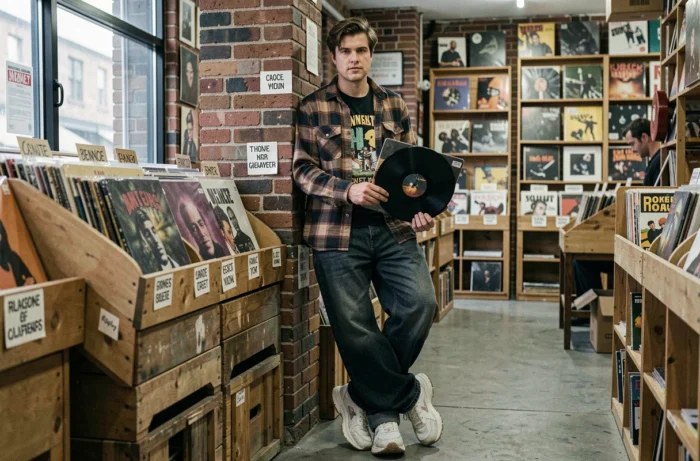
- The oversized and faded jeans, paired with sneakers, constituted the uniform of late grunge. Its loose fit has been reintroduced almost identically in recent collections from several houses.
- The flannel shirt, often worn open over a plain t-shirt, functioned as a layering piece that remains popular in second-hand circuits.
In September 2026, Kendall Jenner wore a Giorgio Armani dress from the Fall-Winter 1995 collection on the red carpet at the Venice Film Festival. This reappearance illustrates a specific phenomenon: the value of the designer archive surpasses the mere reproduction of a retro look. Wearing an original piece from 1995 is not a nostalgic gesture; it is a fully-fledged fashion choice.
Jil Sander Minimalism vs. Versace Glamour: Two Visions of the Body in 1995
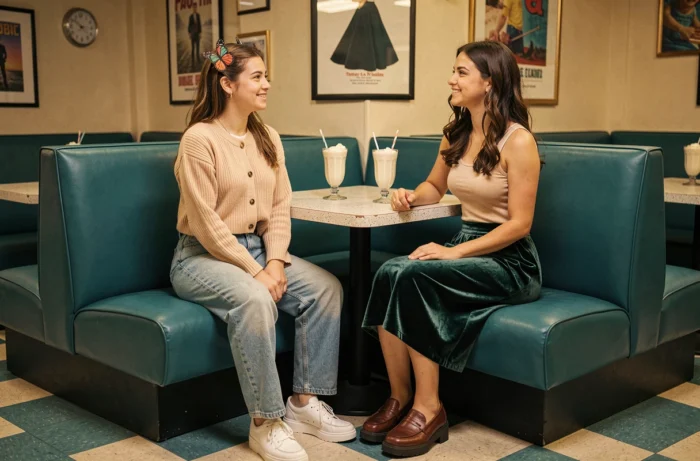
The fashion of 1995 offered two radically opposed relationships to the body. Jil Sander’s minimalism erased curves under fluid suits and neutral colors. In contrast, Versace’s structured glamour emphasized them with almost architectural precision.
These two approaches reflected different audiences and contexts. Minimalism appealed to a professional and intellectual milieu that valued discreet dressing. Versace’s creations targeted a more festive scene, linked to parties and the world of entertainment.
Asymmetrical Resurgence in the 2020s
The return of these two currents has not been symmetrical. Miu Miu and Prada have extensively cited the minimalist vocabulary of the years 1994-1996 in their 2022 collections, with micro-skirts, cropped cardigans, and volumes identical to those of the time. Sculptural glamour, on the other hand, remains more marginal on current runways, confined to red carpet contexts.
The minimalism of 1995 produced a structural legacy, integrated into the fundamentals of contemporary wardrobes. The sculptural glamour of the same year functions more as a sporadic citation.
1995 Fashion and Popular Culture: Beyond Clueless
Reducing the fashion of 1995 to the film Clueless or the series Friends would miss the point. These productions certainly popularized a certain preppy and accessible style (pleated mini-skirts, coordinated sets, Gap or Tommy Hilfiger basics), but they represented only a fraction of the wardrobe spectrum of that year.
The music scene played an equally structuring role. Grunge, even at the end of its cycle after Kurt Cobain’s death in 1994, continued to influence street fashion. Independent labels and Marc Jacobs translated this energy into wearable collections, while London runways welcomed McQueen’s first provocations.
The fashion of 1995 drew its richness from this coexistence between a smooth television mainstream and more radical creative currents. The fact that archive pieces from this year are worn on red carpets three decades later confirms that this tension has produced garments of rare durability, far beyond the simple effect of cyclical fashion.