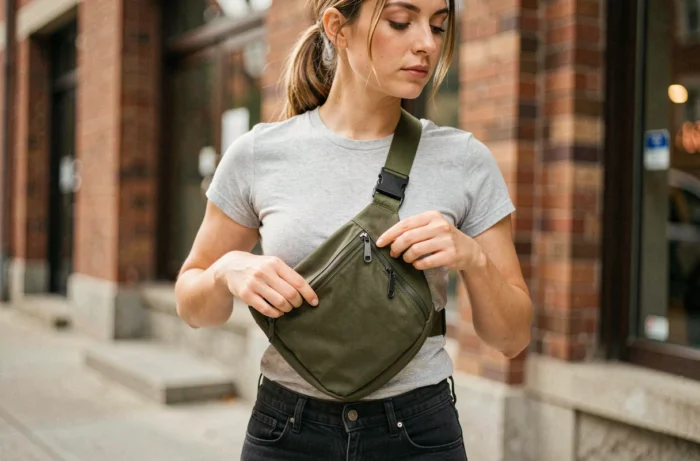
The adjustment range of a fanny pack strap directly determines the number of usable carrying positions. A strap that is too short limits use to a belt carry on a slim build, while a strap that is too long creates slack, unwanted oscillations, and premature wear on the tightening buckle.
Choosing the right strap length involves balancing three parameters: the actual bust circumference, the intended carrying mode, and the useful adjustment range of the adjustment system.
Adjustment range and useful length: the specifications that matter
Most product sheets indicate a total strap length, sometimes a maximum and minimum length. This raw data is not enough. What determines the versatility of a fanny pack is the useful adjustment length, which is the difference between the shortest and longest positions that can be used without the strap floating or compressing.
Properly defining the strap length for a fanny pack suitable for your build requires understanding this concept of useful length, not just the total length stated.
On classic fashion models, the range is around 110 to 120 cm in total length. Models designed for crossbody or chest bag carrying display significantly wider ranges, sometimes from 80 to 130 cm of extended length. The inclusive sizing trend is pushing some brands to offer straps exceeding 140 to 150 cm, which opens shoulder carrying to larger builds.
The useful length also depends on the mechanism. A simple sliding buckle offers continuous adjustment but may slip under load. A double pass buckle holds the position better, at the cost of slower adjustment. A continuous adjustment with a firm lock is the best technical compromise.

Measuring your bust circumference: a reliable method before purchase
The waist measurement is not enough. Carrying crossbody or across the chest requires measuring the bust circumference, which includes the thickness of the torso. For a classic belt carry, the relevant measurement is the waist circumference taken over usual clothing, not against the skin.
Quick measurement protocol
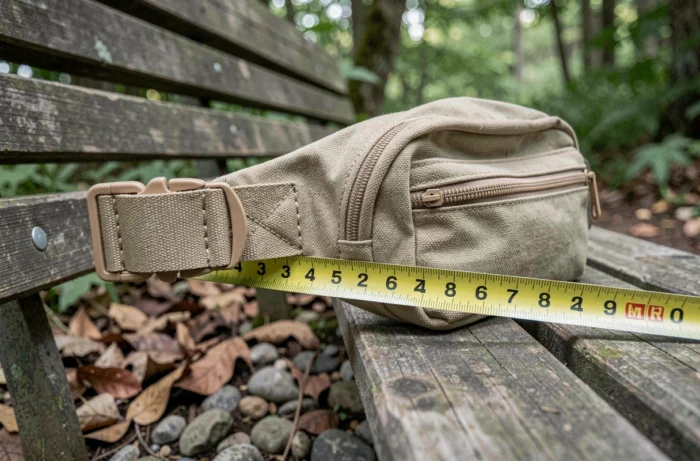
- Wrap a flexible measuring tape around the bust at the level where the bag will be carried (waist for belt carry, chest for crossbody), over a garment of usual thickness.
- Add a comfort margin of a few centimeters to avoid compression, and account for seasonal thickness (coat, technical jacket).
- Compare this measurement to the minimum and maximum range of the strap, ensuring that the value falls within the middle third of the adjustment range, not at the upper or lower limits.
We recommend never buying a strap whose maximum length exactly matches your bust circumference. Being at the adjustment limit means zero margin for adjustment and constant tension on the buckle, which accelerates wear.
Belt carry, shoulder carry, or crossbody: the length changes according to use
The same fanny pack worn at the waist, over one shoulder, or across the chest does not require the same strap length. The belt carry requires the shortest length, usually at the lower end of the adjustment range. The shoulder carry adds the height of the shoulder to the waist circumference. The crossbody carry, on the other hand, requires the longest length since the strap crosses the torso diagonally.
The current convergence between fanny packs, slings, and chest bags has led manufacturers to offer adjustment ranges wide enough to cover these three uses in one product. Recent product guides announce ranges from about 80 cm to 130 cm on the same model, which corresponds to the necessary range to transition from waist carry to crossbody carry for the majority of body types.
The crossbody carry on a build above average requires a strap of at least 140 cm. If you alternate carrying positions, prioritize a model whose range covers all your uses without reaching the limits.
Strap width and attachment: two parameters linked to length
The width of the strap interacts with the length in terms of comfort. A thin strap (below 25 mm) concentrates pressure on a narrow band. The longer the strap and the heavier the bag, the more this point pressure becomes uncomfortable, especially in crossbody carry where the strap goes over the neck or shoulder.
For a fanny pack loaded beyond just a phone and keys, we recommend a width of at least 30 mm combined with a length suitable for the intended carry. The combination of a long strap and a thin strap is the worst configuration in terms of comfort under load.
Attachment points and durability
The method of attaching the strap to the body of the bag affects durability. Attachments via D-ring or swivel carabiner distribute stress better than a simple direct stitch. On a long strap, lateral tension in crossbody carry puts significant strain on the attachment point. A swivel attachment reduces strap twisting and limits seam wear.
- Direct stitched attachment: suitable for short straps and exclusive belt carry.
- D-ring with pass: a good compromise for versatile waist and shoulder use.
- Swivel carabiner: recommended for crossbody carry or for frequently alternating positions.
The choice of strap length for a fanny pack is not just a single number. It is the match between the adjustment range, the carrying mode, and the body type that produces a reliable fit. It is better to have a strap whose range slightly exceeds your needs than a model that puts you at the adjustment limit from the first try-on.