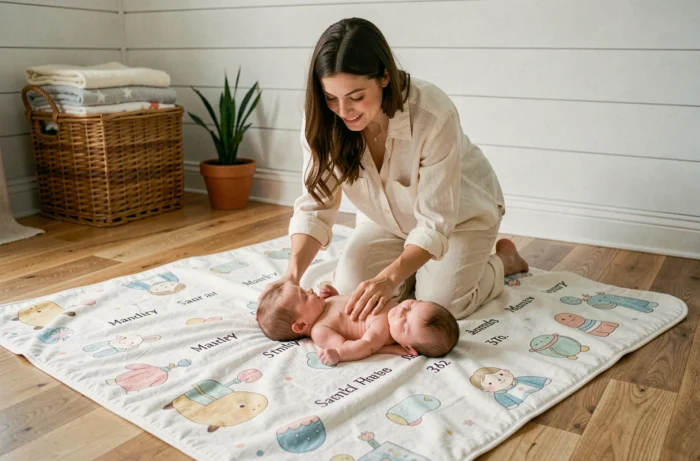
The milestone blanket is not just a photo accessory. It is a technical textile subject to specific regulatory requirements, the quality of which determines both the visual appeal of the photos and the safety of the child placed on it. Here we detail the criteria that consumer products often overlook.
Textile Safety and European Regulations for Baby Blankets
Since December 13, 2024, the European GPSR Regulation (EU) 2023/988 applies to all home textiles, including baby blankets, even handmade items sold online. Any milestone blanket marketed in Europe must undergo a documented risk analysis, kept for ten years, with complete traceability (manufacturer identification, batch number).
At the same time, REACH chemical compliance imposes strict limits on azo dyes, formaldehyde, phthalates, and heavy metals. For a product in prolonged contact with an infant’s skin, these limits are non-negotiable.
The EN 14682 standard on cords and decorative elements for children’s textiles also applies to blankets. Ribbons, pom-poms, and decorative arches sewn onto certain models must adhere to maximum lengths and tear resistance tests. We recommend checking for a certificate of conformity before any purchase, especially on marketplaces where traceability remains fragile.
Finally, Regulation (EU) No. 1007/2011 mandates fiber composition labeling in the language of the country of sale. A seller shipping a milestone blanket to France without a label in French is in violation.
Weight, Weave, and Photo Quality of an Original Baby Milestone Blanket
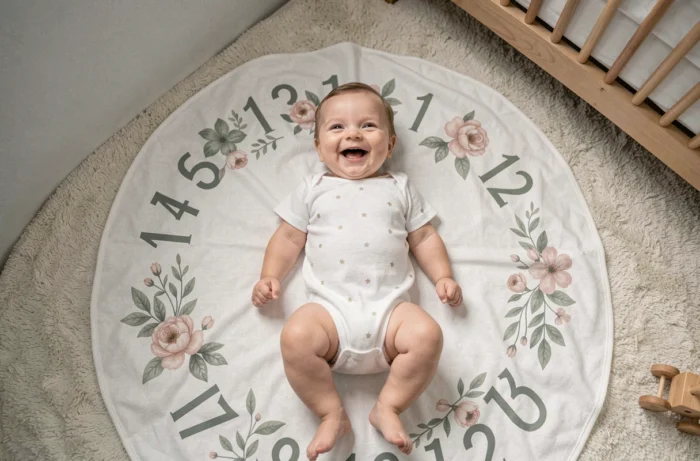
The choice of fabric directly affects the quality of milestone photos. We observe that competing products focus on printed patterns without addressing the textile characteristics that make a difference at the time of shooting.
A fabric that is too lightweight creates unsightly wrinkles as soon as the baby moves. Conversely, a sufficiently dense fabric (like fleece or minky) remains taut and provides a uniform background. Cotton fleece, being more matte, absorbs light better and limits unwanted reflections that a flash or natural side light can create on a shiny synthetic fabric.
For those looking for the baby milestone blanket on Maman Bébés, the weave criterion deserves as much attention as the design. An organic cotton jersey, for example, combines softness to the touch and neutral photographic rendering, two qualities rarely found in entry-level models.
Background Color and White Balance
Light and desaturated shades facilitate photo post-production. An off-white or pearl gray background allows the camera (or smartphone) to set its white balance without color drift. Blankets with sage green or navy blue backgrounds, very trendy, often require manual correction to restore a natural complexion to the baby.
High-contrast patterns (large black and white blocks) attract the infant’s gaze and distract them, complicating the shot. A discreet, repetitive, and tone-on-tone pattern remains the best compromise between aesthetics and practicality.
Personalized or Unisex Milestone Blanket: Concrete Selection Criteria
The market segments blankets into three categories: girl, boy, unisex. This marketing classification obscures the real decision-making parameters.
- The durability of the print takes precedence over the pattern. A sublimation print withstands dozens of washes without fading, whereas a vinyl flocking cracks after a few machine cycles. For monthly use during the first year, sublimation is the preferred method.
- The size of the blanket should be considered based on framing. A square format of about one meter on each side leaves enough margin for a portrait framing with the monthly marker visible, even as the baby grows and spreads out more from the sixth month onward.
- The included accessories (wooden frame, arrow, felt crown) must comply with the EN 14682 standard. Any small removable element poses a choking hazard, especially once the baby starts putting objects in their mouth.
- A model personalized with an embroidered name makes a sought-after birth gift, but the embroidery adds local thickness that can cast a shadow in the photo if the light comes in at an angle.
Monthly Photo Protocol: Capturing Usable Memories
We find that most failed milestone photos are not due to the blanket but to the shooting protocol. A few simple rules can radically change the outcome.
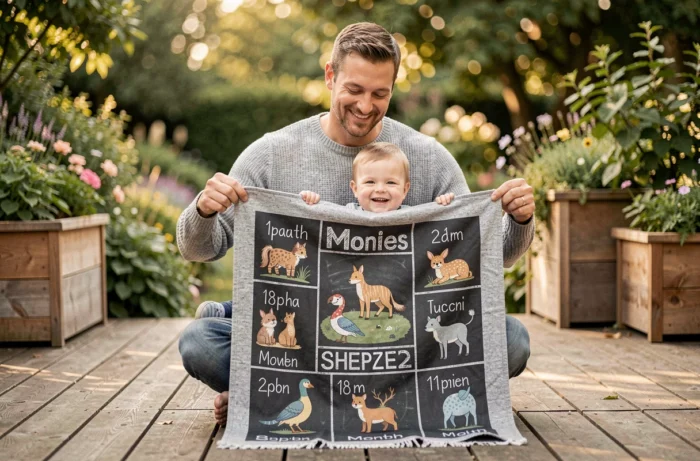
Always photograph in the same place, at the same time, ensures visual consistency across the twelve photos of the first year. Indirect natural light (near a window, without direct sunlight) remains the most flattering source for an infant’s skin.
Placing the milestone blanket flat on the ground and positioning oneself strictly vertically above the baby eliminates perspective distortions. A stable stool or chair is sufficient. Photos taken diagonally from the edge of the bed produce a trapezoidal effect that distorts the text printed on the blanket.
Managing Movement from the Fourth Month
As soon as the baby starts to roll over, the shooting window shrinks to a few seconds. Two strategies work: the burst mode of the smartphone (ten to fifteen shots in two seconds, then sort them) or the presence of a second adult who keeps the baby’s attention with a sound toy placed just above the lens.
The final result depends as much on the textile as on the method. An original baby milestone blanket, compliant with current standards and adapted to photographic constraints, transforms a simple monthly ritual into a series of coherent memories that the family will cherish well beyond the first year.