Comparing senior support options often comes down to two variables: the level of loss of autonomy and the type of response mobilized. Since the “Aging Well and Autonomy” law of April 8, 2024, the French regulatory framework has significantly evolved, particularly with the merger of the former home help services (SAAD) and nursing care services (SSIAD) into a unified structure. This new arrangement changes the way personalized solutions are deployed daily for elderly individuals.
Home Autonomy Service: What the SAAD-SSIAD Merger Changes
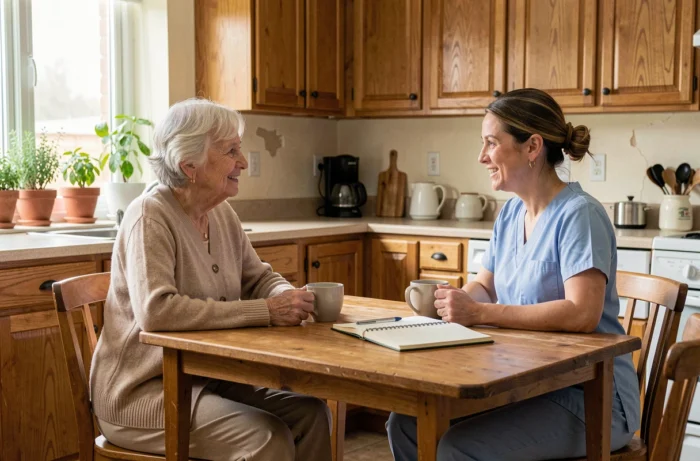
Before the reform, a senior experiencing loss of autonomy often had to coordinate with two distinct contacts: a home help service for daily tasks and a nursing care service for medical follow-up. The Home Autonomy Service (SAD) merges these two aspects into a single operator.
The direct benefit is the elimination of administrative duplication. A single intervention plan now covers meal assistance, housing maintenance, personal hygiene, and paramedical care. For families, this reduces the number of files to be created and the risks of disruption in the care pathway.
Not all departments are implementing this merger at the same pace. The Court of Auditors has recommended a pragmatic approach, taking into account the local realities of each territory. In rural areas, where healthcare professionals are scarcer, the grouping into SAD can accelerate care because the same caregiver coordinates the entire follow-up.
For seniors seeking comprehensive care, senior support via Your Health Assistant offers an integrated approach that considers this coordination logic.

Personalized Senior Support: Comparison of Current Systems
The choice between different options depends on the degree of autonomy, budget, and family environment. The table below summarizes the main options available under the current regulatory framework.
| System | Target Audience | Scope of Intervention | Medical Coordination |
|---|---|---|---|
| Home Autonomy Service (SAD) | Seniors with moderate to severe loss of autonomy | Daily assistance + nursing care | Integrated (single plan) |
| Classic Home Help (provider) | Autonomous or slightly dependent seniors | Housekeeping, shopping, meals, companionship | Not included |
| Day Care | Isolated seniors or those with cognitive disorders | Stimulation, activities, meals on-site | Partial (on-site follow-up) |
| Temporary Accommodation | Seniors post-hospitalization or respite for caregivers | Housing, meals, care for a limited duration | Complete during the stay |
The SAD stands out for its medical coordination integrated into the assistance plan, which spares families from acting as intermediaries between multiple structures. In contrast, for a still-autonomous senior who simply needs help with housekeeping or shopping, classic home help remains the most flexible and least expensive solution.
Departmental Public Autonomy Service: A One-Stop Shop for Guidance
The law of April 8, 2024, also created the Departmental Public Autonomy Service (SPDA). Its role is to bring together existing actors (departments, pension funds, MDPH, home services) around four common missions.
- Welcoming, informing, and guiding seniors and their caregivers towards the solution that best fits their situation
- Assessing the level of loss of autonomy and allocating corresponding benefits (notably APA)
- Ensuring personalized follow-up of the pathway to avoid disruptions between home, hospital, and facility
- Developing a proactive approach, meaning identifying isolated elderly individuals who do not take steps on their own
The SPDA has been piloted in 18 departments in 2024 before its gradual rollout across the entire territory. For families, the concrete gain is a single entry point: instead of contacting the town hall, the departmental council, and the pension fund separately, a single contact directs them to the appropriate system.
This one-stop shop logic changes the game for family caregivers, often faced with a fragmented administrative pathway. The SPDA does not replace existing structures, but it networks them, which reduces processing times and file duplication.
Maintaining Seniors at Home: Criteria That Guide the Choice
Not all personalized solutions are equal depending on the profile of the senior concerned. Three criteria allow for quick decision-making.
Level of Dependence and Need for Care
A senior classified as GIR 1 or 2 (high dependence) requires near-constant presence and daily care. The SAD or medicalized accommodation becomes necessary. For a GIR 5 or 6, a few hours of housekeeping per week is generally sufficient to maintain comfort of life.
Presence or Absence of a Family Caregiver
Caregiver burnout remains the leading cause of institutional placement. When a relative provides most of the support, temporary accommodation or day care can help relieve this burden without interrupting home care.
Housing Configuration
An apartment on an upper floor without an elevator, a bathroom not adapted, or a steep staircase can make home maintenance risky, even with daily support. Adapting the housing often determines the viability of staying at home, even before considering financing or the type of service chosen.
The ongoing reform, with the SAD and the SPDA, is gradually reshaping the landscape of senior support in France. The main change lies less in the nature of the aids than in their articulation: a better-coordinated pathway, an identified contact, and intervention plans covering both daily life and care. For families, the most useful reflex remains to contact the departmental welcome point at the first signs of loss of autonomy.