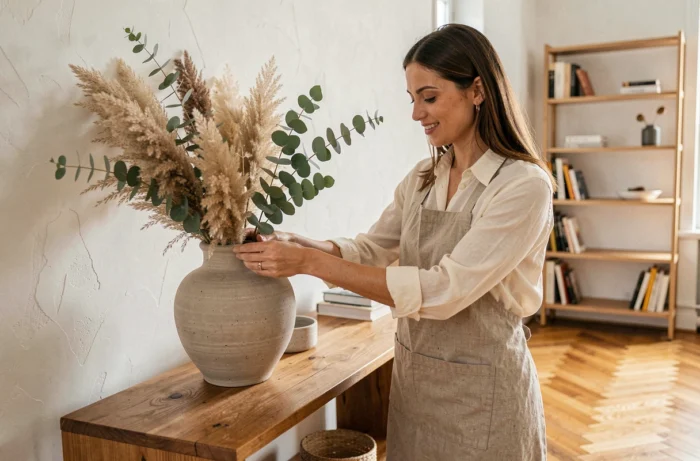
Transforming an interior is not just about choosing a sofa or repainting a wall in off-white. The decoration of a home relies on concrete trade-offs between colors, volumes, lighting, and furniture, whose visual impact varies depending on the room and available space. This article compares the most effective transformation levers to decorate your home with style, based on their relative cost and real effect on the ambiance.
Unique focal point or accumulation of decorative objects: what really changes a room
The 2026 decoration trends mark a clear shift. Rather than multiplying accessories on every shelf, recent approaches recommend focusing attention on a unique focal point per room: a sculptural light fixture, a boldly designed piece of furniture, or a wall painted in a strong color.
This logic alters the way a decoration budget is allocated. Investing in a single strong piece (designer armchair, oversized pendant light, imposing mirror) creates a more pronounced visual effect than spreading the same amount across small objects. Interiors that appear “designed by an architect” almost all follow this principle.
To explore different approaches to interior decoration, the home page of Sous Tous les Angles gathers ideas that illustrate this philosophy of targeted choice well.
Accumulation, on the other hand, creates visual saturation that can be exhausting. A living room with three vases, two candles, a decorative tray, and a stack of books on the coffee table often gives an impression of a catalog rather than a lived-in space.
Bold colors vs. neutral palettes: comparison table by room
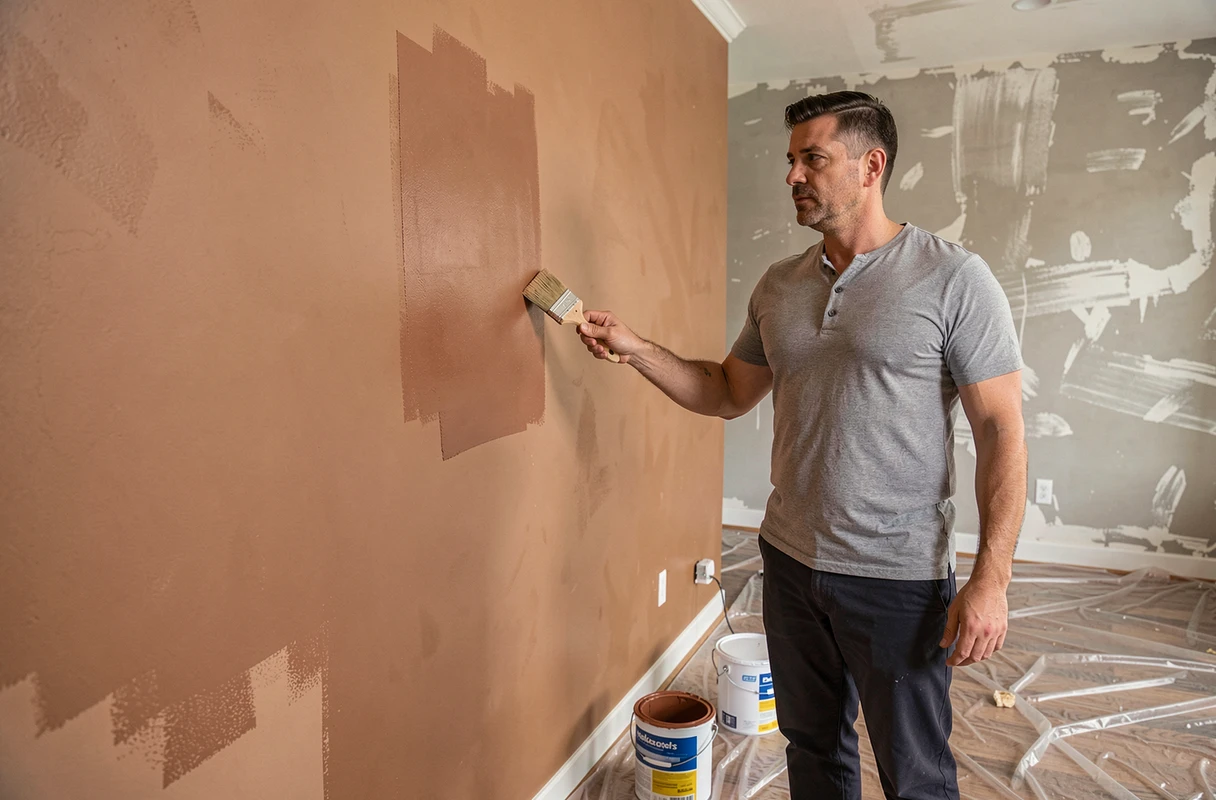
The choice of colors remains the most accessible lever for changing the atmosphere of a home. The 2026 trends move away from all-neutral to reintroduce bolder colors and expressive materials. The table below summarizes the differences in effect depending on the room concerned.
| Room | Neutral palette (beige, white, gray) | Bold color (terracotta, deep blue, sage green) |
|---|---|---|
| Living Room | Visually enlarges, but risks monotony | Creates a cocoon effect, enhances the focal point |
| Kitchen | Easy to match with existing furniture | Enlivens the space, draws attention to a wall or facades |
| Bedroom | Soothing, suitable for small spaces | Adds character, works on a single wall (headboard) |
| Entryway | Little impact on a passage space | Immediate “first impression” effect, even in a few square meters |
Switching to a bold color does not require repainting the entire room. One painted wall is enough to change the perception of a space, provided you choose the one that draws the eye (facing the entrance door in a living room, behind the bed in a bedroom).
Layered lighting: the technique that replaces the single ceiling light
A central ceiling light provides illumination, but it flattens volumes. The layered lighting technique involves overlapping three levels of light in the same room:
- A diffuse ambient light (pendant light, floor lamp directed towards the ceiling) that defines the overall brightness without glare.
- A targeted functional light (desk lamp, reading lamp, under-cabinet spots) that supports a specific activity.
- An accent lighting (architectural garland, directional spotlight on a painting) that highlights the chosen focal point.
This layering radically transforms the atmosphere of an interior, even in a small space. A living room that only had a ceiling light gains depth as soon as a floor lamp at seating height and indirect lighting behind a piece of furniture are added.
Color temperature: a detail that changes everything
Cool white bulbs (above 4,000 K) give a clinical appearance. For a warm style in the living room or bedroom, sources between 2,700 and 3,000 K remain the reference. In the kitchen, a slightly higher temperature improves visual comfort during meal preparation.
Modular furniture and hidden storage: optimizing space without sacrificing style
Solutions for small spaces have evolved. Recent content emphasizes more technical approaches than simply placing a mirror against a wall: modular furniture, integrated storage, and suspended structures allow for freeing up floor space without compromising aesthetics.
A wall-mounted TV unit, for example, visually clears the bottom of the wall and makes cleaning easier. An entryway bench with integrated storage replaces both the shoe rack and the extra seating. These choices are as much about design as they are about organization.
Height optimization remains underutilized in most interiors. Installing shelves between the tops of doors and the ceiling creates storage without encroaching on living space. In a kitchen, full-height storage columns hold more than traditional upper cabinets while offering a cleaner visual line.
Preview before purchase: a reflex that avoids mistakes
Simulation tools now allow you to visualize a piece of furniture in its actual room in a photo before ordering. This step reduces returns and disappointments related to proportions. A corner sofa that seems compact in a showroom can overwhelm a living room of less than twenty square meters.
Textures and materials: what distinguishes a “decorated” interior from a lived-in one
The layering of textures adds a dimension that color alone does not produce. A corduroy sofa paired with a jute rug and linen cushions creates a tactile contrast that brings the room to life.
Natural materials (raw wood, stone, rattan, artisanal ceramics) age better than synthetic finishes. They gain character over time, whereas a laminated piece of furniture shows its limits after a few years of use.
Three different textures in the same space are enough to create visual richness without falling into excess. Beyond that, the risk is to produce an uncontrolled flea market effect rather than a stylish interior.
Decorating a home with style is less about the quantity of objects than about the coherence of choices. A well-placed focal point, a bold color on a supporting wall, structured layered lighting, and complementary textures: these four levers, combined, transform an ordinary space into a personal interior.