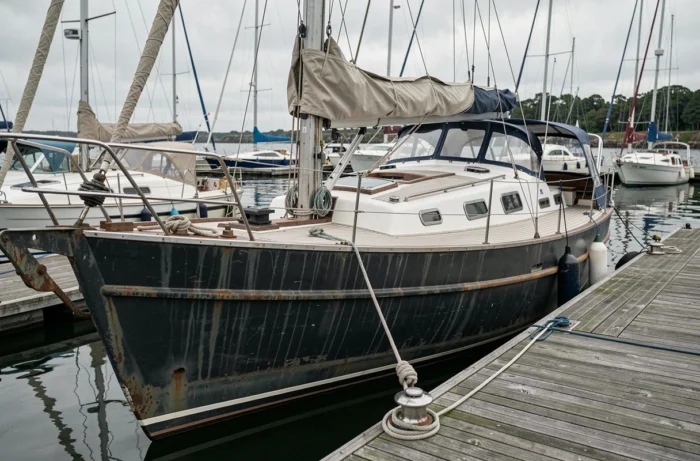
A steel sailboat refers to a vessel whose hull and, most often, the deck are constructed from welded steel plates. This material, used for decades in large cruising units, is distinguished by its mechanical resistance to impacts and its ability to be repaired in almost any port in the world.
In the second-hand market, these sailboats represent a distinct segment, with prices often lower than those of composite or aluminum hulls of equivalent size.
Hull Thickness and Repairability: What Steel Changes in Practice
The fundamental property of a steel hull is its impact tolerance without structural failure. Where a polyester hull may crack or delaminate after a serious grounding, steel deforms. A dent in a plate can be straightened, ground down, and rewelded. This operation can be performed by a skilled welder, not necessarily a specialized shipyard.
For an offshore sailing project, this characteristic carries significant weight. While docked in an isolated port, finding an arc welding station is far more realistic than locating a laminator capable of working with composite materials correctly. The repairability of steel is not a theoretical argument; it is a measurable logistical advantage as soon as one moves away from traditional recreational areas.
Before diving in, it is wise to buy a second-hand steel sailboat by consulting specialized listings that detail the construction history and condition of the hull.

Second-Hand Steel Sailboat: Why Prices Remain Accessible
The second-hand market for steel sailboats follows a particular dynamic. These units attract a specific buyer profile (long-distance travelers, DIY owners) and remain less sought after than catamarans or standardized polyester monohulls. This lower demand pressure creates a direct advantage for the buyer: negotiation margins are wider.
A well-equipped cruising steel sailboat built in the 1980s or 1990s trades for a fraction of the price of a recent composite of comparable length. The depreciation affects the perceived value of the material, not the actual strength of the vessel. For a given budget, the buyer gains access to a more robust boat, often better equipped for long voyages, with rigging and interior layout designed for autonomy.
The Cascade Effect on Insurance
Yachting insurance premiums for offshore navigation are generally calculated as a percentage of the declared value of the hull. A second-hand steel sailboat, whose market value is lower than that of a modern catamaran or a large composite sailboat, mechanically generates a lower annual premium for equivalent coverage. This differential can represent a significant recurring saving on an annual cruising budget.
Corrosion Control on a Steel Sailboat: Key Points to Watch
Steel has a known enemy: rust. However, corrosion on a well-built and properly maintained hull is not a foregone conclusion. It can be managed methodically. Here are the areas and actions to check when purchasing a second-hand steel sailboat:
- The ultrasonic thickness measurement of the plate is the priority check. It allows for comparing the residual thickness to the original thickness and identifying areas of material loss, particularly below the waterline and around the through-hulls.
- The welds of the frames and stringers, especially in hard-to-reach areas (under the berths, behind the tanks), should be visually inspected. A plumber’s endoscope is sufficient to explore these nooks.
- The electrical circuit deserves special attention: faulty wiring or poorly connected grounds can cause galvanic electrolysis that accelerates localized corrosion around metallic through-hulls.
- The state of the cathodic protection system (sacrificial anodes) should be checked. Anodes consumed by more than half indicate either a necessary recent renewal or a leakage current in the electrical circuit.
A steel sailboat whose hull thickness remains close to original values after several decades reflects serious maintenance. This is a more reliable signal than a fresh coat of paint or a newly refurbished interior.
Steel or Aluminum Sailboat: Selection Criteria for Offshore Navigation
Aluminum (often referred to as “alu” in nautical vocabulary) shares with steel the resistance to impacts and weldability. The main difference lies in weight and price. An aluminum sailboat is lighter at equal volume, which improves performance under sail. In contrast, its construction and resale costs are significantly higher.
For a second-hand buyer with a controlled budget, steel offers the best strength-to-price ratio on the market. The additional mass of the steel hull results in a boat that is more stable in rough weather, at the cost of slightly lower speed when running. In cruising navigation, where comfort and safety take precedence over pure performance, this compromise is often relevant.
Additionally, aluminum requires specific precautions (prohibition of certain antifoulings, risk of galvanic corrosion when in contact with other metals) that complicate routine maintenance. Steel, from this perspective, tolerates approximations and varied environments better.
Lifetime of a Steel Hull and Resale Potential
A properly sandblasted and protected steel hull can sail for several decades without significant structural loss. The longevity of the material explains why sailboats built in the 1970s and 1980s remain in active service today, with perfectly healthy hulls after thickness measurement.
The resale of a steel sailboat targets a market of connoisseurs. Potential buyers know what they are looking for: a robust, autonomous boat suited for demanding navigation. The transaction sometimes takes longer than for a mainstream polyester sailboat, but the sale price remains stable for well-maintained and documented units (maintenance log, thickness measurement reports, work history).
The second-hand steel sailboat remains one of the most rational entry points into long-distance cruising. A material that can be inspected, repaired, and insured at a lower cost, combined with contained market prices, constitutes a combination that is hard to match for those prioritizing reliability over prestige.