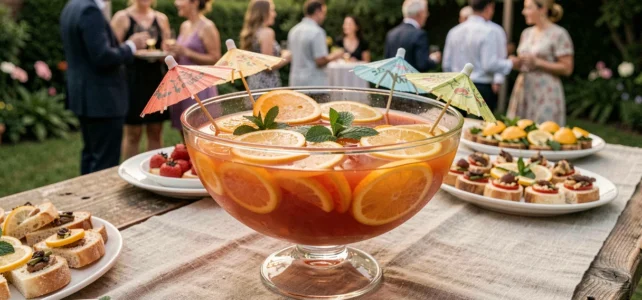
You are hosting twenty people on Saturday evening and you are looking for a simple, refreshing drink that everyone will enjoy. The Jacqueline cocktail checks all these boxes: white wine, lemonade, and a splash of grenadine. The recipe consists of three ingredients. The challenge is to transition from a glass to a ten-liter bowl without losing the balance of flavors or becoming overwhelmed at serving time.
Ratio and flavor balance when multiplying volumes
Multiplying a recipe by ten does not mean multiplying each ingredient by ten. This is the classic trap when scaling up. The grenadine syrup, which is very sweet and colorful, takes over as soon as you increase the amount.
For a format of about ten liters, the principle remains that of a light punch: the base of white wine represents about half of the total volume. The lemonade makes up the other half, and the grenadine syrup does not exceed a few centiliters per liter of mixture. Specifically, for ten liters, count on five liters of dry white wine, five liters of lemonade, and one bottle of grenadine syrup (about 70 cl).
When you want to prepare the Jacqueline aperitif in large quantities, always taste after pouring only half of the syrup. Then adjust with small doses. Too much grenadine masks the wine and turns the cocktail into a sweet drink for children.
Why dry white wine instead of a sweet wine? Because the lemonade and grenadine already bring a lot of sugar. A dry white wine balances the whole and maintains a sensation of freshness. A Entre-Deux-Mers, a Muscadet, or a Picpoul works very well without breaking the budget.

Temperature and service: keeping the Jacqueline fresh throughout the evening
A lukewarm Jacqueline cocktail loses all its appeal. The lemonade loses its bubbles, the sugar becomes cloying, and the white wine does not express itself as well. The serving temperature is the factor that makes the difference between a successful aperitif and a bowl of leftovers that no one finishes.
Pre-chill each ingredient separately
Place the white wine and lemonade in the refrigerator for at least four hours before mixing. The grenadine syrup can stay at room temperature, as its volume is too small to warm up the entire mixture.
Do not rely on ice cubes to cool down ten liters of drink. Ice cubes melt quickly in a large volume and dilute the cocktail. Their role is to maintain the temperature, not to lower it. If your ingredients are lukewarm, even two kilos of ice will not be enough.
Fountain, bag-in-box, or bowl: which container to choose
The market for large-format cocktails has evolved significantly in recent years, with bag-in-boxes and fountains becoming common for serving punches at events. For home use, three options work well:
- The glass bowl with a ladle remains the most convivial format for an evening of fewer than thirty people. It allows you to see the color of the cocktail and to serve easily.
- The drink fountain with a tap (models from five to eight liters) offers self-service. Prepare two fountains rather than one ten-liter one, to keep one cool while the other is being served.
- The XXL ice bucket, in which you immerse a closed bottle, keeps the temperature longer than an open bowl exposed to ambient air.
Prepare the mixture at the last moment to preserve the bubbles of the lemonade. If you mix two hours before the guests arrive, the drink will be flat at serving time.
Variations of the Jacqueline cocktail to surprise your guests
The classic recipe is a starting point. You can evolve it without altering its essence, as long as you respect the basic architecture: a sparkling or still wine, a sweet carbonated drink, and a colored syrup.
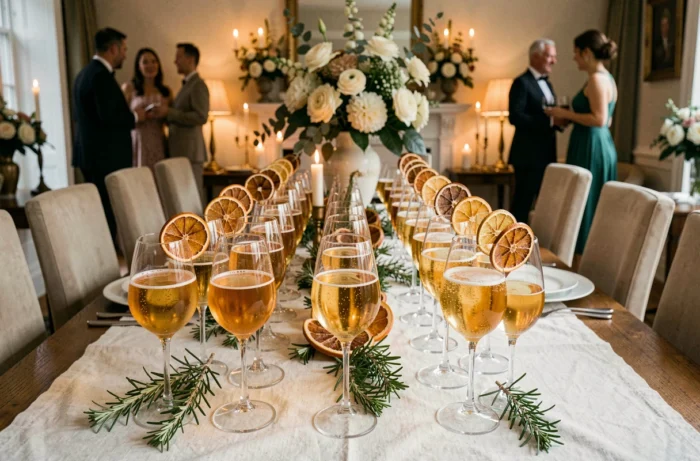
Replace the white wine with Crémant or Champagne for a more festive version, suitable for weddings or New Year’s Eve. The cost increases, but the mouthfeel is significantly finer. A Crémant from Alsace or Loire offers a good compromise between price and quality for a large volume.
For a rosé Jacqueline, substitute the grenadine with rose or lychee syrup. The color remains in the pink tones, but the taste changes radically. Add a few slices of lime and fresh mint leaves to the bowl for a neat presentation.
Are you hosting people who do not drink alcohol? The structure also works in a non-alcoholic version: replace the white wine with sparkling white grape juice or tonic. The result visually resembles the original version, which avoids stigmatizing those who do not consume alcohol.
Quantities per person and managing leftovers
Have you ever noticed that we always overestimate the quantities for an aperitif? For a Jacqueline cocktail served as an aperitif (not as an evening drink), count two to three glasses per person, or about 30 to 40 cl. For twenty guests, eight liters are more than enough. Ten liters leave a comfortable margin.
If the Jacqueline is the only drink offered throughout the evening, increase to five glasses per person. In this case, plan for fifteen liters and double the proportions of the base recipe.
- For 10 people as an aperitif: 2.5 L of white wine, 2.5 L of lemonade, 35 cl of grenadine.
- For 20 people as an aperitif: 5 L of white wine, 5 L of lemonade, 70 cl of grenadine.
- For 30 people as an aperitif: 7.5 L of white wine, 7.5 L of lemonade, 1 L of grenadine.
Leftovers can be stored in the refrigerator, but the lemonade will have lost its fizz by the next day. One tip: keep the wine-grenadine mixture and add fresh lemonade just before serving again. The white wine mixed with grenadine can be stored for two days in the fridge without any problem.
Always prepare a little less than planned, even if it means opening an extra bottle of lemonade during the evening. It is better to have a slight shortage than an excess of five liters of flat cocktail the next morning.