
The messaging system of INSA Rouen Normandie remains a central tool for students and staff, but accessing it from a smartphone is not always straightforward. Between the web portal, the configuration of a native email client, and recent developments in authentication, several paths coexist, each with its own constraints.
IMAP Protocol and Technical Settings to Configure INSA Rouen Email on Smartphone
Competitors often simply list the visual steps without detailing the technical foundation. The mobile configuration of INSA Rouen’s messaging relies on the IMAP protocol with SSL/TLS encryption for receiving emails, and SMTP with mandatory authentication for sending. This setup works on both Android and iPhone.
One technical point deserves special attention: the format of the identifier. Several recent feedbacks on similar academic messaging systems indicate that the full email address is gradually replacing the short identifier in mobile configurations. Entering only the login without the domain (the part after the @) regularly leads to connection errors, without an explicit error message on the user side.
For those who wish to access the INSA Rouen webmail on mobile via an email client, it is necessary to have three elements before starting: the full address, the INSA account password, and the names of the incoming (IMAP) and outgoing (SMTP) servers of the institution.
INSA Rouen Webmail in the Mobile Browser: Shortcut and Limitations
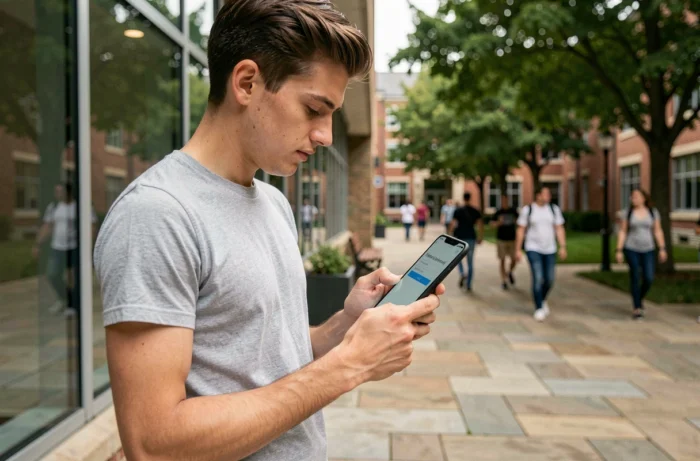
Configuring an email client is not the only option. Accessing via a mobile browser remains functional and requires no technical setup. Simply go to the INSA Rouen Normandie webmail portal, authenticate via the central authentication service (CAS), and then check messages directly in the web interface.
This method has an often underestimated advantage: it does not store any messages on the phone. For a shared smartphone or a personal device used in a professional context, this limits data exposure in case of loss or theft.
It is possible to create a shortcut on the phone’s home screen for near-app access, without going through the App Store or Play Store. On both Android and iOS, the process takes a few seconds:
- Open the webmail in the browser (Safari on iPhone, Chrome on Android) and log in normally
- Use the browser’s share menu, then select “Add to Home Screen”
- Name the shortcut (for example, “Mail INSA”) and confirm
However, this approach requires re-logging in for each session, which can become cumbersome on a daily basis. Push notifications also do not work with a simple browser shortcut, unlike an email client configured with IMAP.
Enhanced Authentication and Security of Remote Access in Normandy
Mobile access to academic messaging systems is evolving in terms of security. According to recent publications, two-factor authentication is progressing on remote access for institutions in Normandy. This development potentially concerns connections from a network outside the campus, which includes almost all mobile usage.
In practice, two-factor authentication adds a step after entering the password: a temporary code sent via SMS, or validation through an authentication app (such as Microsoft Authenticator or FreeOTP). Field feedback varies on this point, as deployment seems to be gradual depending on profiles (students, researchers, administrative staff).
For a user configuring an IMAP email client on their phone, enabling two-factor authentication may require generating a specific application password, distinct from the usual password. This technical detail is not always documented in institutional guides and can block the connection without a clear explanation.
What This Changes for Mobile Configuration
If two-factor authentication is active on the account, logging in via the browser works normally (the second factor is requested at each session). However, an IMAP email client may refuse the connection if the standard password is used instead of the dedicated application password.
The recommendation in this case is to check in the security settings of the INSA account if an “application password” or “third-party application” option exists, and to generate a specific password for the phone’s email client.
Native Email Client or Third-Party Application: Which Choice for INSA Rouen Webmail
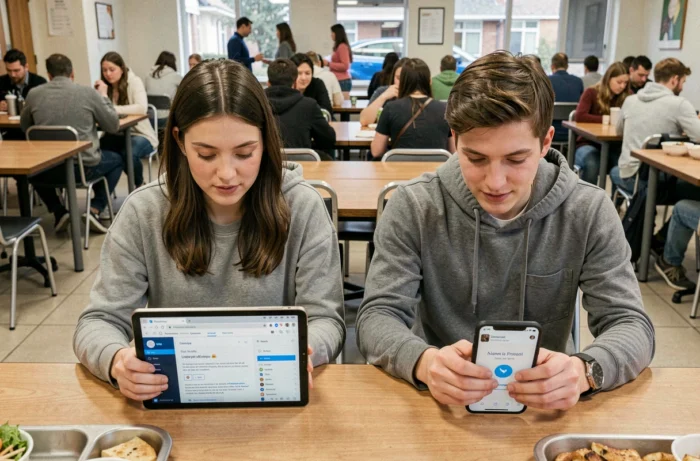
The choice of the application used on the phone has a direct impact on the ease of configuration. Native email clients (Mail on iOS, Gmail on Android) sometimes automatically detect the IMAP/SMTP settings from the entered address, but this is not guaranteed for academic domains like that of INSA Rouen Normandie.
Third-party applications like Microsoft Outlook mobile or Thunderbird offer more accessible manual configuration options. A tutorial from another INSA (Lyon) details, for example, the configuration via Outlook on Android, with activation of advanced settings and manual entry of the server. The logic remains the same for Rouen; only the server names change.
- iOS native client (Mail): configuration via Settings > Mail > Accounts > Add Account > Other, then manual entry of the IMAP and SMTP servers
- Android native client (Gmail): Settings > Add Account > Other, selecting IMAP type and entering server information
- Mobile Outlook: account addition with choice of Exchange or IMAP, activating advanced settings to force the correct server
- Mobile Thunderbird (K-9 Mail): complete manual configuration, with fine control of SSL/TLS encryption
The choice between these options mainly depends on the level of control desired. For simple use (checking and replying to emails), the native client of the phone is sufficient in most cases. For more advanced use (folder management, filters, multiple signatures), a third-party application offers more flexibility.
The CAS authentication page of INSA Rouen Normandie reminds users of a point of vigilance that also applies on mobile: before entering their credentials, check that the URL of the site starts with the official domain of the institution. Phishing attempts targeting academic messaging systems exist, and a smartphone screen makes URL verification less intuitive than on a computer.